Somewhere beneath the ash and pumice of Pompeii, a room lay dormant that would have made even the wealthiest Roman green with envy. Not because of its size — a mere nine square metres — but because of its colour: a deep, heavenly blue that cost a fortune.
In the summer of 2024, archaeologists unearthed a remarkable chamber at the heart of Pompeii. The Blue Room, as it has since become known, is part of a luxurious urban villa in Regio IX. The house featured a thermal bath, a central courtyard, and a dining hall that could seat twenty to thirty guests. And yet it was this unassuming space — a so-called sacrarium, a domestic shrine for religious rituals — that left scientists breathless.
Egyptian blue: the world's first synthetic pigment
Egyptian blue, known to the Romans as caeruleum, is the oldest synthetic pigment known to humankind. No colour was more coveted or more costly among Pompeii's elite. It was created by heating a mixture of sand, lime, copper, quartz, and an alkaline binder. The result: a striking colour that was exclusive, technically complex, and expensive. Puteoli, a trading port twenty miles from Pompeii, was the primary production centre for this pigment throughout the entire Roman Empire in the 1st century AD.
Blue as a status symbol and religious language
The cost of this room was high — very high. Based on prices recorded by Pliny the Elder, the paint for this small chamber would have cost the equivalent of 50 to 90 percent of a legionary's annual salary. Or to put it differently: more than a thousand loaves of bread. And that's before labour costs. Displaying status in Antiquity came with a very tangible price tag.
Among Pompeii's elite, wall paintings were a greater status symbol than mosaics — and no colour was more sought-after than Egyptian blue. The walls of the Blue Room are not solely blue: female figures representing the four seasons adorn the walls. The fact that the most expensive colour was reserved for such an intimate, religious space says everything about the significance colour carried in the Roman world.
A journey back in time
Inside the room, fifteen jugs, oil lamps, and three decorative boxes were found, alongside building materials. Researchers therefore believe the room was being renovated prior to the volcanic eruption — yet another piece of evidence that the owners carried on with their lives until the very last day, unaware of the catastrophe bearing down on them.
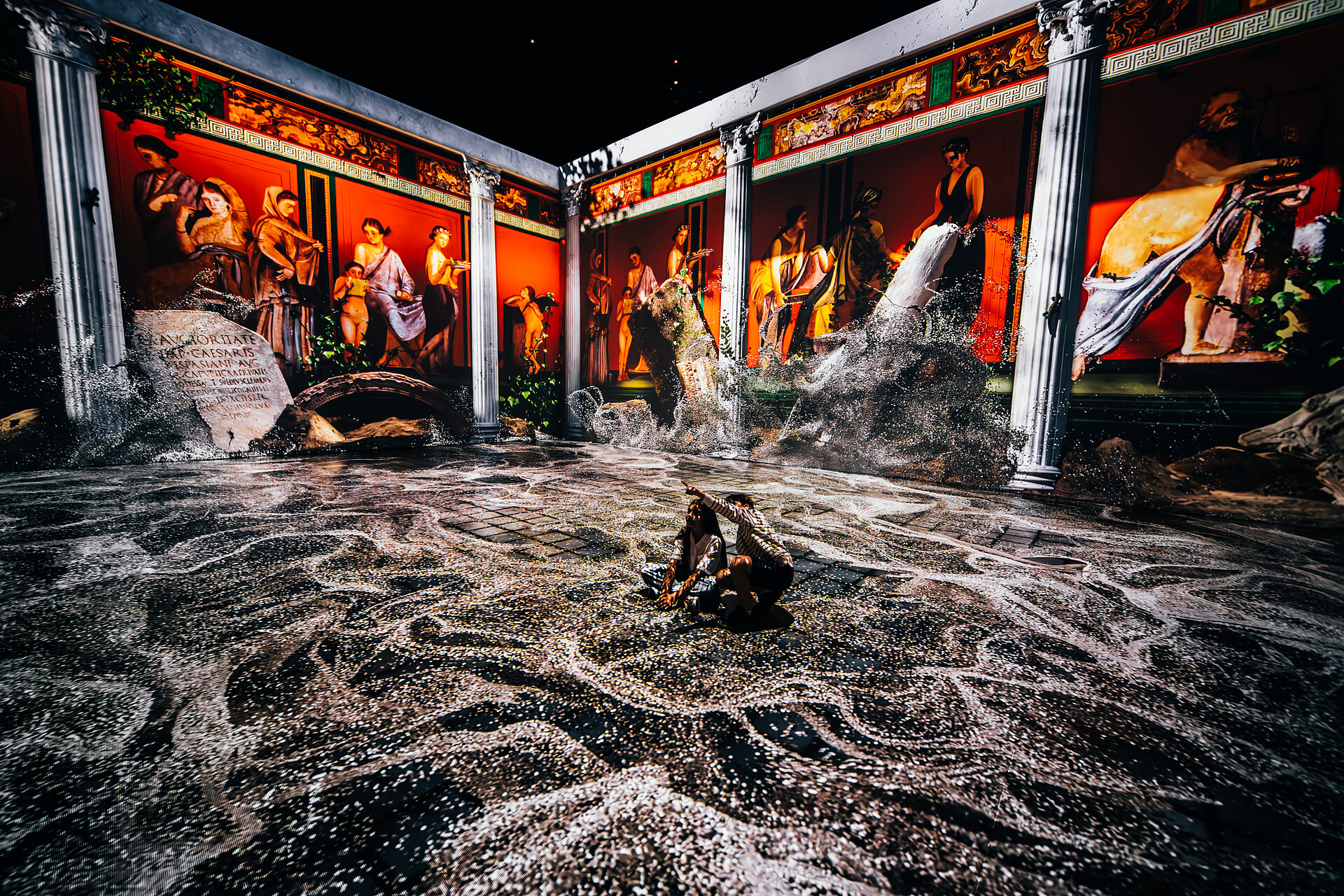
You can discover more at the exhibition The Last Days of Pompeii: The Immersive Exhibition. In the Metaverse Room, you walk through the Villa of the Mysteries. Inside, there is a banquet hall featuring an enormous fresco depicting scenes from the life of the Greek god Dionysus. Those frescoes are painted in the famous 'Pompeian Red'. But experts say that colour isn't original. It was yellow to begin with. The gases leaking from Vesuvius reacted with the yellow pigment and turned it red. So that iconic Pompeian Red is, in fact, a gift from the volcano.
As scientists continue to uncover and decode the secrets of Pompeii, this immersive experience invites everyone — until 17 May — to feel the energy, the culture, and the tragic fate of Pompeii up close. The past has never felt so near.